1. Statutory Context & Judicial Scrutiny in Faculty Appointments
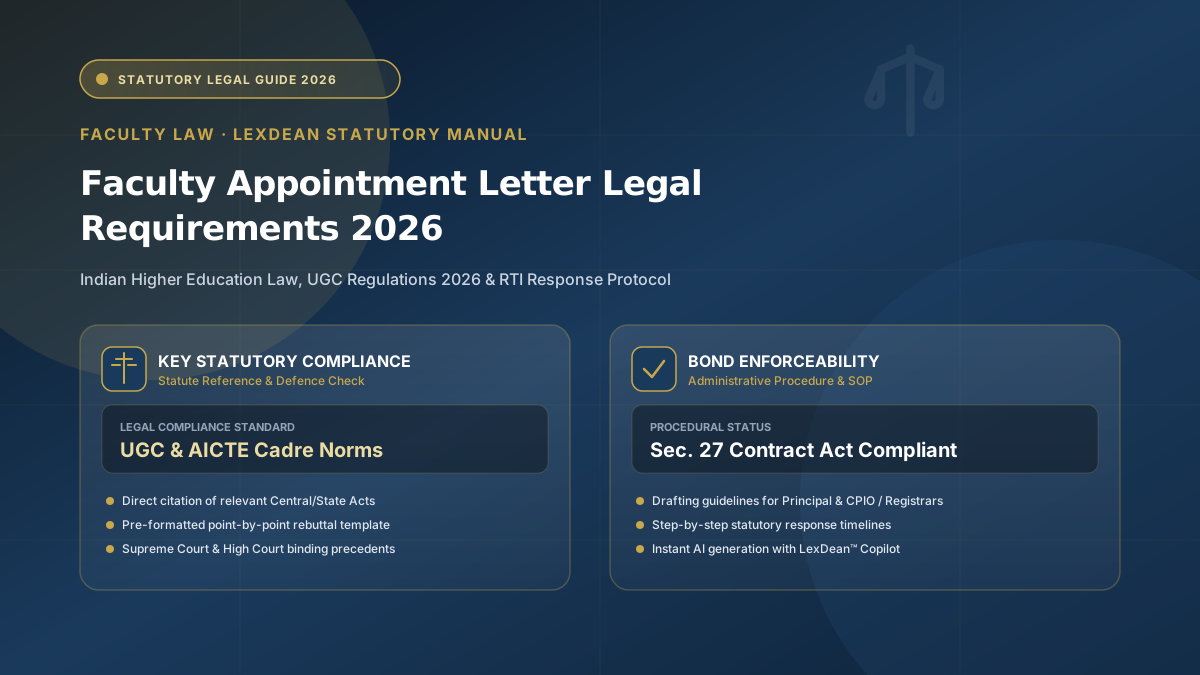
In Indian higher education, a faculty appointment letter is not a standard private employment contract; it is an enforceable statutory instrument governed by university acts, state higher education service rules, and apex regulatory frameworks. Both central and state universities, as well as private un-aided affiliated colleges, operate under strict regulatory supervision regarding faculty service conditions.
The Supreme Court of India in K. Krishnamacharyulu v. Sri Venkateswara Hindu College of Engineering (1997) 3 SCC 571 established that faculty members in private unaided institutions perform a public duty and are entitled to parity in service conditions, making institutional appointments amenable to writ jurisdiction under Article 226 of the Constitution of India. Consequently, an improperly drafted appointment order exposes the Governing Body and Principal to direct litigation, regulatory de-recognition by AICTE/UGC, and severe penal action from affiliating universities.
2. Key Mandatory Legal Clauses for Academic Year 2026-27
Every faculty appointment order issued for Assistant Professors, Associate Professors, and Professors must contain specific non-negotiable statutory clauses to withstand judicial and regulatory scrutiny:
A. Cadre Designation, Academic Pay Level, and Scale Parity
The letter must expressly state the cadre designation, Pay Band, and Academic Level corresponding to the 7th Central Pay Commission (7th CPC) or applicable State Pay Commission scales as mandated under the UGC Regulations on Minimum Qualifications for Appointment of Teachers and Other Academic Staff in Universities and Colleges. For engineering and technical institutions, alignment with the AICTE Approval Process Handbook (APH) 2026-27 cadre ratio (1:2:6) and entry pay levels is legally mandatory. Ambiguous clauses such as 'consolidated honorarium' without statutory justification invite severe NAAC SSR metric downgrades and affiliating university audits.
B. Probation Period, Performance Metrics, and Confirmation Protocol
The statutory framework requires a clearly defined probation period (typically one year, extendable by another year upon recorded assessment). In State of Punjab v. Dharam Singh (AIR 1968 SC 1210), the Apex Court settled that without an explicit maximum ceiling on probation or an express requirement for a formal confirmation order, disputes regarding 'deemed confirmation' arise. The letter must unambiguously state that probation shall continue until an express written order of confirmation is issued by the Appointing Authority following a formal Performance Based Appraisal System (PBAS) review.
C. Absolute Prohibition of Original Certificate Retention
A frequent compliance violation in private colleges is the withholding of original academic certificates. The UGC Notification on Refund of Fees and Non-Retention of Original Certificates and AICTE Redressal of Grievance Regulations strictly prohibit institutions from retaining original educational documents, degree certificates, or migration certificates. Incorporating any clause mandating the surrender of original certificates constitutes an illegal practice under the UGC Act 1956, inviting withdrawal of 2(f)/12(B) status.
Facing a Legal Notice or RTI Query in Your College?
LexDean AI generates point-by-point, statute-referenced official replies tailored to Indian Higher Education Law in just 2 minutes.
Free में Reply Draft करो →3. Statutory Strategy: Service Bonds, Notice Periods & Restraint of Trade
Colleges frequently struggle with sudden mid-semester resignations. However, attempting to enforce punitive service bonds or arbitrary financial penalties frequently fails judicial scrutiny.
- Section 27 of the Indian Contract Act, 1872: Agreements restraining an employee from exercising a lawful profession, trade, or business are void. In
Percept D'Mark (India) Pvt. Ltd. v. Zaheer Khan (AIR 2006 SC 3426), the Supreme Court affirmed that post-service restrictive covenants and non-compete clauses are completely unenforceable under Indian law. - Liquidated Damages vs. Penalty (Section 74): A college cannot levy arbitrary penalties for early resignation. An institution may only recover genuine pre-estimated losses actually incurred on specialized induction or academic training programs, properly substantiated with itemized proof of expenditure. General clauses demanding 'six months gross salary' are routinely struck down as unconscionable under
Central Inland Water Transport Corp. v. Brojo Nath Ganguly (1986) 3 SCC 156. - Statutory Notice Period: A mutual notice period of one to three months (or payment of salary in lieu thereof), structured so that faculty are not relieved mid-semester to safeguard students' academic interests, is legally defensible when balanced equally between both parties.
Statutory Alert: Do not include clauses stipulating forfeiture of earned salary, Gratuity, or Provident Fund against unserved notice periods. The Payment of Gratuity Act, 1972 and the Employees' Provident Funds and Miscellaneous Provisions Act, 1952 are overriding statutory welfare enactments that supersede private contractual terms.
4. Integration of Mandatory Compliance Frameworks (POSH, IPR, and Code of Conduct)
Every modern faculty appointment letter must expressly integrate the college's statutory administrative machinery:
I. POSH Act 2013 and UGC POSH Regulations 2015
The appointment must explicitly bind the employee to the Sexual Harassment of Women at Workplace (Prevention, Prohibition and Redressal) Act, 2013 and the UGC (Prevention, Prohibition and Redressal of Sexual Harassment of Women Employees and Students in Higher Educational Institutions) Regulations, 2015, noting that violation constitutes gross misconduct entailing summary disciplinary action.
II. Academic Integrity and Research IPR
In compliance with the UGC (Promotion of Academic Integrity and Prevention of Plagiarism in Higher Educational Institutions) Regulations, 2018, the contract must stipulate institutional ownership of patents/IPR generated utilizing college infrastructure, while safeguarding the author's moral rights and enforcing strict disciplinary penalties for plagiarism.
III. Statutory Code of Conduct and Disciplinary Rules
Reference must be made to the applicable State Affiliating University First Statutes (e.g., Code of Conduct for College Teachers). Termination for misconduct must strictly mandate adherence to the principles of natural justice (issuance of a detailed Show Cause Notice, charge-sheet, and conduct of a Domestic Enquiry under an independent Enquiry Officer).
5. Summary: How LexDean AI Protects Academic Managements
Drafting watertight faculty contracts requires precision harmonizing UGC norms, AICTE guidelines, affiliating university acts, and constitutional labor precedents. LexDean AI eliminates institutional liability by auto-generating customized, legally vetted Appointment Letters, Service Agreements, and Probation Confirmation Orders tailored to your state jurisdiction in under two minutes.
With built-in compliance guards against unlawful document withholding, invalid non-compete clauses, and defective termination mechanisms, LexDean safeguards College Registrars and Principals against High Court writ petitions and regulatory non-compliance.