1. Overview & Statutory Genesis of Anti-Ragging Laws in India
Ragging in Indian Higher Educational Institutions (HEIs) has transitioned from an internal disciplinary concern to a stringent statutory offense carrying direct criminal liability and administrative derecognition. The legal framework governing anti-ragging compliance is anchored in landmark Supreme Court directives, primarily Vishwa Jagriti Mission v. Central Government (2001) and the comprehensive guidelines formulated following the Prof. R.K. Raghavan Committee Report in University of Kerala v. Council, Principals' Colleges, Kerala & Ors. (2009).
Pursuant to these judicial mandates, the University Grants Commission (UGC) notified the UGC Regulations on Curbing the Menace of Ragging in Higher Educational Institutions, 2009 (updated through subsequent gazette amendments). Parallel statutory mandates are enforced by the All India Council for Technical Education (AICTE) via the AICTE Approval Process Handbook (APH), the National Medical Commission (NMC), and the Bar Council of India (BCI). Non-compliance no longer results in mere administrative warnings; it exposes College Principals, Directors, Registrars, and Management trustees to personal prosecution under the Bharatiya Nyaya Sanhita, 2023 (BNS) for abetment, criminal negligence, and concealment of cognizable offenses.
2. Mandatory Composition of the Anti-Ragging Committee (ARC)
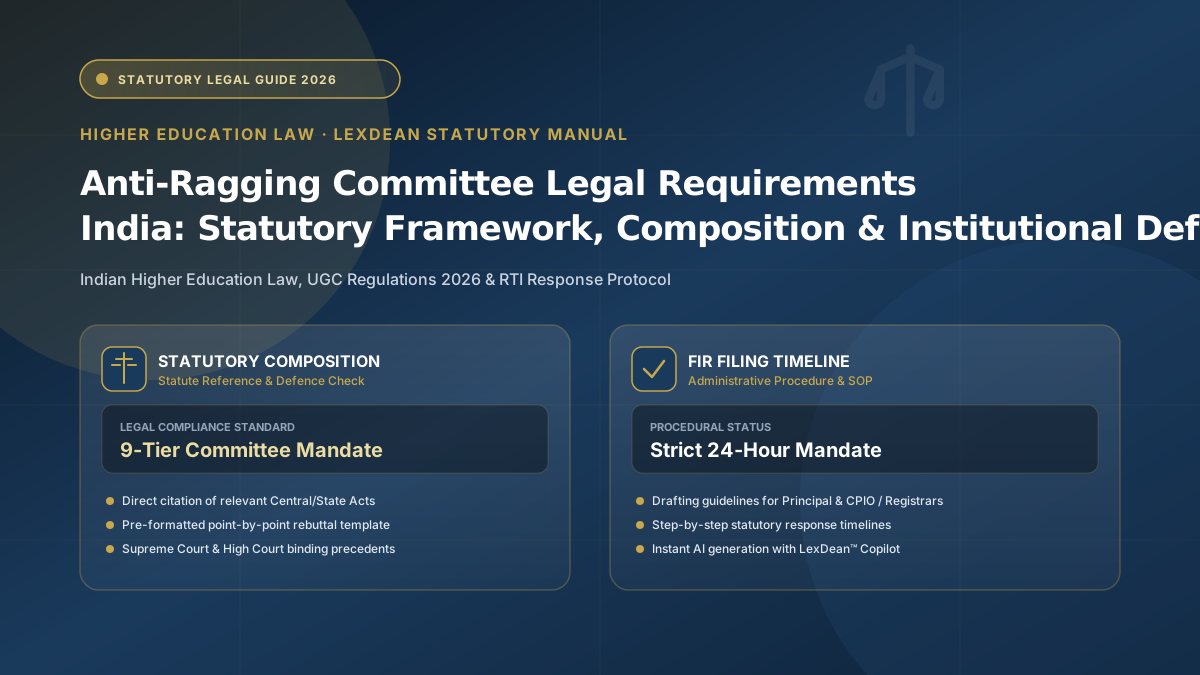
Under Clause 6.3(a) of the UGC Regulations, every HEI—whether a central, state, deemed, or private university or affiliated standalone college—is legally obligated to constitute an Anti-Ragging Committee (ARC) at the institutional level before the commencement of each academic year. The composition is statutory and non-discretionary.
The institutional Anti-Ragging Committee must mandatorily comprise:
- Head of the Institution (Chairperson): The Principal, Director, or Vice-Chancellor.
- Civil Administration Representative: An officer nominated by the District Magistrate/Sub-Divisional Magistrate (SDM) not below the rank of Tehsildar or Deputy Collector.
- Police Administration Representative: A police officer nominated by the Superintendent of Police (SP) or Deputy Commissioner of Police (DCP), typically the Station House Officer (SHO) of the local jurisdictional police station.
- Local Media Representative: An accredited journalist or representative from regional/national print or electronic media.
- Non-Governmental Organization (NGO): A representative of an active youth-development or human rights NGO working in youth welfare.
- Faculty Representatives: Senior academic members representing both sciences/humanities and hostel wardens.
- Parent Representatives: Parents of both freshers (first-year entrants) and senior students.
- Student Representatives: Enrolled students belonging to both the fresher cohort and senior academic years.
- Non-Teaching Staff Representative: A designated administrative staff member (Registrar, Administrative Officer, or Estate Officer).
Delineation: Anti-Ragging Committee (ARC) vs. Anti-Ragging Squad (ARS)
Institutions frequently commit fatal procedural errors by conflating the Anti-Ragging Committee (ARC) with the Anti-Ragging Squad (ARS). Under Clause 6.3(c) of the UGC Regulations, the ARC is an overarching, quasi-judicial policy, inquiry-review, and punitive body, whereas the ARS is a dynamic, operational vigilance apparatus. The ARS must consist of institutional faculty and staff members who have no external affiliations. The ARS is empowered to conduct unannounced, surprise raids across hostel premises, canteens, recreational grounds, and surrounding student housing clusters at night and during vulnerable hours.
Facing a Legal Notice or RTI Query in Your College?
LexDean AI generates point-by-point, statute-referenced official replies tailored to Indian Higher Education Law in just 2 minutes.
Free में Reply Draft करो →3. Standard Operating Procedures (SOP) & Statutory Timeline for Incident Response
When a complaint of ragging is received through the UGC National Anti-Ragging Helpline (1800-180-5522), institutional drop-boxes, verbal intimation, or the online reporting portal, the Head of the Institution is bound by strict procedural timelines:
- Immediate Spot Inquiry (Within 24 Hours): The complaint must be referred instantaneously to the Anti-Ragging Squad. The ARS must conduct an on-the-spot preliminary inquiry, record witness statements under signature, and submit a confidential fact-finding report to the ARC within 24 hours.
- Quasi-Judicial Hearing by the ARC (Within 48 Hours): The ARC must convene an urgent hearing adhering strictly to the Principles of Natural Justice (Audi Alteram Partem). Both the victim and the accused must be provided adequate opportunity to present their case. Crucially, cross-examination by the accused student directly confronting the victim is prohibited to prevent intimidation.
- Mandatory FIR Lodging (Strict 24-Hour Mandate Post-Establishment): If the preliminary inquiry establishes a prima facie cognizable offense,
Clause 7.1 of the UGC Regulationsread with Supreme Court directives mandates the Head of the Institution to lodge a First Information Report (FIR) with the local police station within 24 hours.
Statutory Alert: Failure of the College Principal to lodge an FIR within 24 hours of establishing a prima facie ragging offense constitutes statutory abetment and willful negligence, rendering the administrative head personally liable under Section 223 and Section 3(5) of the Bharatiya Nyaya Sanhita, 2023 (formerly IPC Section 176 and 34).
4. Institutional Punitive Actions & Appellate Mechanisms
Upon receipt of the inquiry findings from the ARC, the institution is legally empowered and obligated to award proportional administrative penalties under Clause 9.1 of the UGC Regulations. Permissible institutional penalties include:
- Suspension from attending classes and academic privileges.
- Withholding or withdrawing scholarships, fellowships, and other financial benefits.
- Debarring from appearing in any test/examination or evaluation process.
- Withholding examination results.
- Debarring from representing the institution in any regional, national, or international meet, tournament, or youth festival.
- Suspension or permanent expulsion from the hostel.
- Cancellation of admission and collective rustication.
- Rustication from the institution for periods ranging from 1 to 4 semesters, or permanent expulsion with debarment from admission to any other institution for a specified period.
Statutory Right of Appeal
An accused student subjected to institutional penalty possesses a statutory right to prefer an appeal within 30 days of the order. The appellate authority for affiliated colleges is the Vice-Chancellor of the Affiliating University; for Deemed Universities, it is the Chancellor; and for autonomous institutes or standalone polytechnics, it is the Chairman of the Governing Council.
5. Audit Readiness: NAAC, NIRF & UGC Regulatory Compliance Records
During National Assessment and Accreditation Council (NAAC) audits (specifically under Criteria 5: Student Support and Progression - Metric 5.1.4) and annual UGC compliance reviews, institutions must present verifiable documentary records. A compliant portfolio must contain:
- Annual Notification of ARC and ARS with individual contact numbers and official email IDs published prominently on the college website and institutional display boards.
- Proof of 100% Submission of Online Anti-Ragging Undertakings by all students and parents via the UGC web portal (
www.antiragging.in). - Roster and Minutes of Mandatory Periodic ARC Meetings (at least three meetings per academic year: Pre-admission, Mid-term, and End-term).
- Logbooks of the Anti-Ragging Squad documenting dates, timings, and faculty signatures for surprise hostel and campus night inspections.
- Documented Action Taken Reports (ATRs) for every complaint routed through the National Anti-Ragging Portal.
6. How LexDean AI Automates Institutional Compliance
Managing anti-ragging compliance under multi-regulator mandates (UGC, AICTE, NMC, BCI) requires impeccable legal precision, bulletproof inquiry documentation, and zero procedural lapses. LexDean AI serves as India's specialized legal co-pilot for Higher Education Administrators:
- Instant ARC & ARS Constitution Orders: Generates legally compliant institutional committee orders incorporating local police and administrative designations with automated statutory tenure validation.
- Automated Natural Justice Inquiry Drafts: Generates show-cause notices, deposition recording templates, cross-examination waivers, and evidence evaluation matrices compliant with High Court jurisprudence.
- 24-Hour Statutory Police FIR & ATR Generator: Drafts formal complaints to local police stations and generates Action Taken Reports (ATRs) formatted specifically for UGC and Affiliating University portals within minutes.