How to Handle RTI First Appeal Before University First Appellate Authority
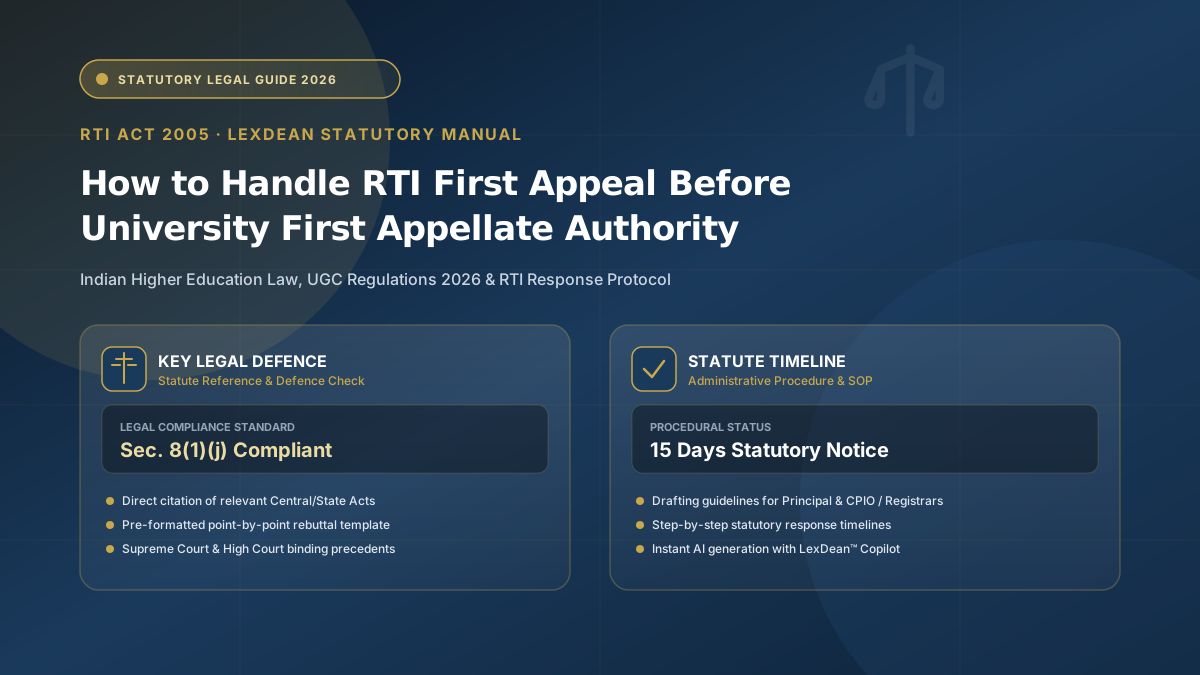
Table of Contents
The Statutory Compliance Challenge in Higher Education Administrations
Across Indian universities, autonomous institutions, and affiliated degree colleges in 2026, educational administrators face a strict regulatory ecosystem. Governing councils, University Grants Commission (UGC) regional offices, State Information Commissions (SIC), and NAAC have transitioned to automated data verification. When evaluating How to Handle RTI First Appeal Before University First Appellate Authority, College Principals, Registrars, and Legal Officers cannot rely on informal paper records.
A single clerical oversight or unstructured reply can expose an institution to severe administrative repercussions, including show-cause notices under Section 14 of the UGC Act 1956, revocation of degree autonomy, and personal financial penalties for Public Information Officers (PIOs) under Section 20 of the RTI Act 2005. Non-compliance also risks irreversible downgrades during NAAC peer team inspections.
Statutory Alert: Limitation Period & Legal Defense
Statutory compliance deadlines are legally non-extendable without formal condonation. When a college receives a notice regarding
How to Handle RTI First Appeal Before University First Appellate Authority, an immediate written acknowledgement and limitation tracker must be created within 48 hours to preserve legal standing before appellate authorities and High Courts.
Establishing an automated, precedent-backed response workflow safeguards the college reputation, defends university affiliations, and ensures operational readiness during inspections.
Core Statutory Framework, Gazette Clauses & Mandatory Records
To construct an airtight administrative defense, college legal teams must organize their documentation around five statutory governance pillars:
- Institutional Committee Governance: Gazette notifications, committee constitution orders, and documented minutes of the
Internal Complaints Committee (ICC)under POSH Act 2013,Anti-Ragging Committeeunder UGC norms, andStudent Grievance Redressal Committee (SGRC). - Transparency & Section 4 Mandates: Compliance with Section 4(1)(b) of the RTI Act 2005, ensuring public directories, faculty rosters, audited accounts, and fee schedules are published on the college portal.
- Faculty Service & Career Advancement Scheme (CAS): Archival of teacher appointment letters, API score verification sheets, and certifications that original academic credentials are not withheld from faculty.
- Equal Opportunity & Accessibility Verification: Certified barrier-free accessibility audits, Equal Opportunity Cell (EOC) reports, and statutory exam concessions under the RPwD Act 2016.
- Disciplinary Due Process Records: Adherence to the Principles of Natural Justice (Audi Alteram Partem), including formal show-cause notices and domestic inquiry findings prior to any student suspension or employee reprimand.
Maintaining these parameters in a unified, tamper-evident digital repository protects institutional trustees against regulatory scrutiny.
Manual Legal Drafting vs LexDean AI Statutory Copilot
Historically, educational institutions faced significant hurdles: costly law firm retainers, delayed turnarounds, and outdated regulatory citations. Comparing manual methods against LexDean AI highlights the operational advantage:
| Operational Parameter | Manual Law Firm Retainer | LexDean AI Legal Copilot |
|---|---|---|
| Response Drafting Turnaround | 5 to 10 Working Days | Under 2 Minutes (Instant) |
| Statutory Precedent Accuracy | Risk of Outdated Case Laws | 100% Valid 2026 High Court & SC Rulings |
| Section 20 Penalty Protection | Risk of Procedural Default | Automated Limitation Tracking & Safeguards |
| NAAC & UGC Inspection Readiness | Scattered Physical Files | 1-Click Audit-Proof Document Export |
| Monthly Institution Cost | ₹25,000 to ₹50,000 / month | From ₹499 / month flat |
Transitioning to an automated legal assistant eliminates legal overheads while producing superior, court-ready submissions in minutes.
Inspection Preparedness & Statutory Action Plan for College Principals
When a regulatory notice or RTI query arrives, college administrative teams must execute this 5-step operational protocol:
- Statutory Verification & Limitation Calculation: Timestamp the receipt date immediately on official registers. Calculate the exact deadline (e.g. 15-day UGC notice window or 30-day RTI window).
- Document Collation Across Departments: Cross-reference the inquiry with verified records, including Governing Body resolutions, committee lists, and audited balance sheets.
- Drafting Point-by-Point Statutory Rebuttals: Address every allegation point-by-point. Specifically cite the governing section, such as
Section 8(1)(j)for employee privacy orUGC Autonomous Regulations Clause 3. - Compiling Authenticated Evidentiary Annexures: Label supporting documents as Annexure A, B, C, certifying each page with the institutional seal and Principal signature.
- Certified Dispatch & Permanent Archival: Dispatch replies via Registered Speed Post (RPAD) and institutional email. Archive the full record bundle for a minimum of 7 years.
How LexDean AI Automates College Legal & Statutory Compliance
LexDean is purpose-built for Indian higher education institutions, offering an autonomous legal copilot engineered for College Principals, Registrars, and Legal Advisors. By ingesting notices and comparing filings against 2026 regulations, LexDean drafts precedent-backed rebuttals in under 120 seconds.
With transparent pricing starting at just ₹499 per month flat for the Pro Plan and ₹999 per month for multi-seat Institution licenses, LexDean provides university administrations with enterprise-grade legal security without expensive retainers.
§ Frequently Asked Questions
Q1. Can a college principal refuse to provide faculty salary details under RTI?
Generally, salary details are considered public information as they are paid from public funds or institutional grants. However, personal bank account details or PAN numbers are strictly protected under Section 8(1)(j) and should be redacted.
Q2. What is the consequence of missing the 15-day notice period for an FAA hearing?
Missing the notice period without a valid request for adjournment can lead to an 'ex-parte' order. The FAA may rule against the college, compelling the disclosure of documents that might otherwise be protected.
Q3. Are NAAC accreditation reports public documents under RTI?
Yes, once the accreditation process is finalized, the final report is typically considered public information. However, internal drafts or preliminary peer-review notes may be protected under Section 8(1)(e) as held in trust by the NAAC/UGC.
Q4. How should we handle an RTI appeal regarding a POSH inquiry report?
Under the POSH Act 2013, the confidentiality of the proceedings is paramount. You must invoke the exemption under Section 8(1)(j) and the specific confidentiality provisions of the POSH Act to deny the request, citing the protection of privacy for the complainant and respondent.
Q5. Does the RTI Act apply to private unaided colleges?
The applicability depends on whether the institution receives 'substantial financing' from the government. If your institution is deemed a 'public authority' under Section 2(h), you are legally bound to comply with the RTI Act.
Automate College Legal Rebuttals with LexDean AI
Eliminate legal anxiety. Ingest notices, cross-reference 2026 regulations, and draft precedent-backed replies in under 2 minutes. Starting at ₹499/month flat.